All work

East Side Pot Shop Rainbow Factory

A shared knowledge management system that helps a community ceramics studio preserve glaze testing results instead of repeating the same experiments.

My role

Information Architecture, Systems Design & Documentation

Company

East Side Pot Shop

Tools

Google Sheets

Disciplines

Information Architecture · Systems Design

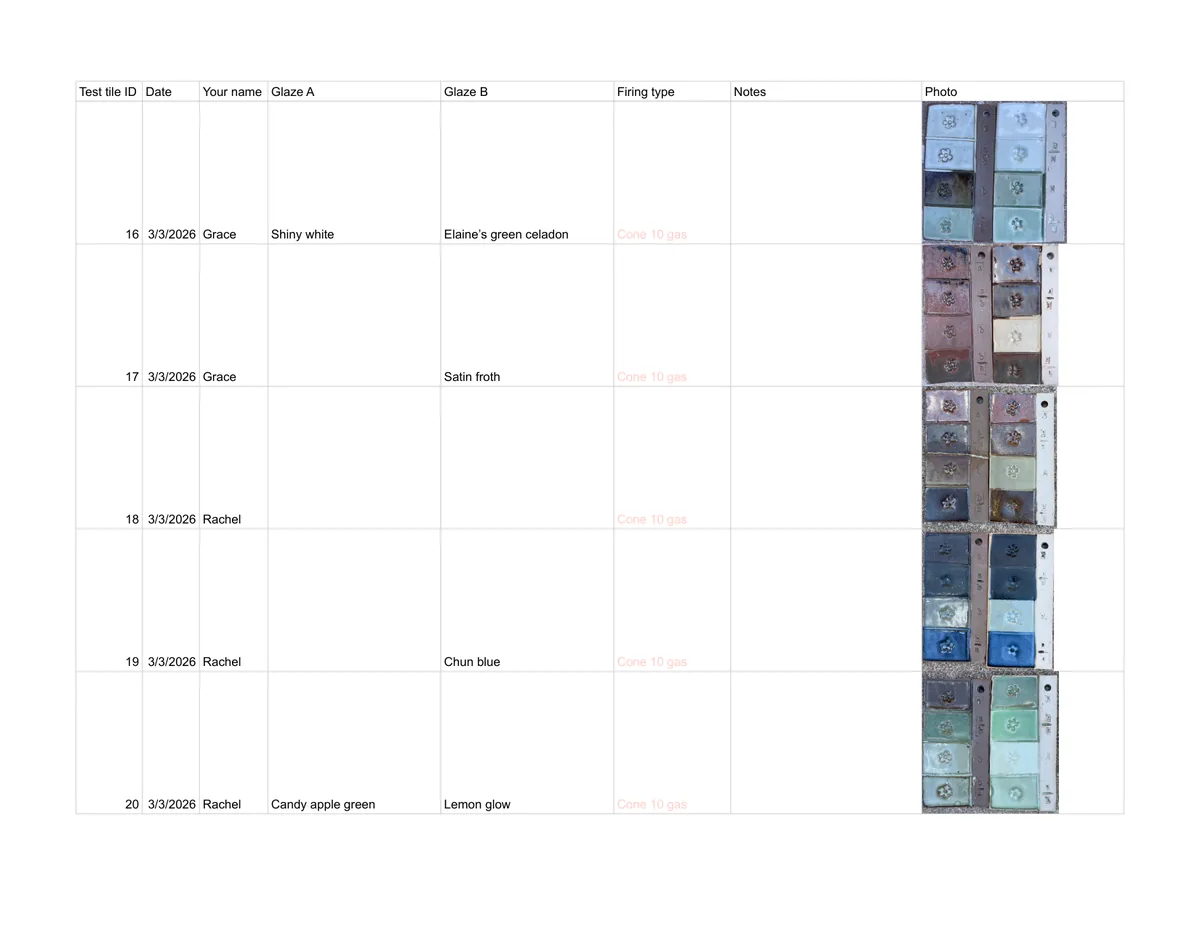
Completed Results log showing multiple contributors' glaze test entries

Completed Results log showing contributions from multiple studio members over time.

The problem

East Side Pot Shop is a community ceramics studio where members work independently while sharing materials, kilns, and firing schedules. With around 50 studio glazes, there are thousands of possible glaze combinations, far more than any one potter could ever test.

Like many studios, glaze testing happened informally. People experimented for their own work, and the results largely stayed with them. If someone had already tested Chun Blue over Mac Celadon, the next person interested in that combination had no reliable way to know it had already been tried.

There was also no shared way to preserve those discoveries. Members might keep notes in a sketchbook, save photos on their phone, or simply remember what they'd learned. The studio already had curiosity and technical expertise; it lacked a system for preserving, organizing, and sharing that knowledge across contributors.

Turning a physical testing method into a shared knowledge system

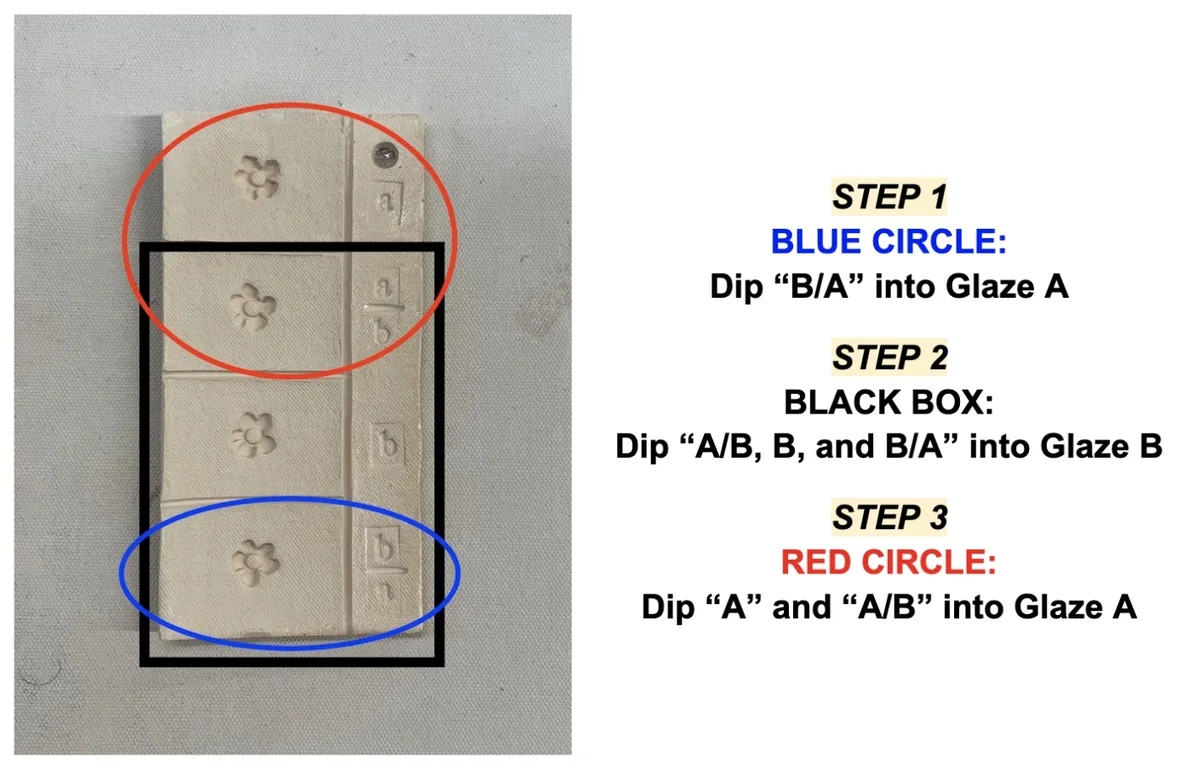
My ceramics teacher developed the physical testing methodology for the project. She created a standardized way to make glaze test tiles so every experiment could be compared consistently, including the test tile design, glazing process, and use of both red and white clay bodies.

My role was to design the information architecture around that methodology, creating a documentation system that could turn individual glaze tests into a searchable, shared record that a community of roughly 100 members could continue building over time.

Annotated dipping instructions showing the blue circle, black box, and red circle steps

Illustrated instructions showing the standardized dipping process.

Designing a workflow that prevents duplicate work

With so many possible glaze combinations, it was easy for members to unknowingly repeat tests someone else had already done. I needed a way for people to check existing results and claim new combinations without making the process overly complicated.

I organized the spreadsheet around two stages: In Progress and Completed Results. Before glazing, members filter both tabs by Glaze A, Glaze B, and Firing Type. If the combination already exists, they can reference previous results instead of repeating the test. If it doesn't, they claim it by adding a row to In Progress before beginning their test. This reservation step prevents multiple people from unknowingly testing the same combination.

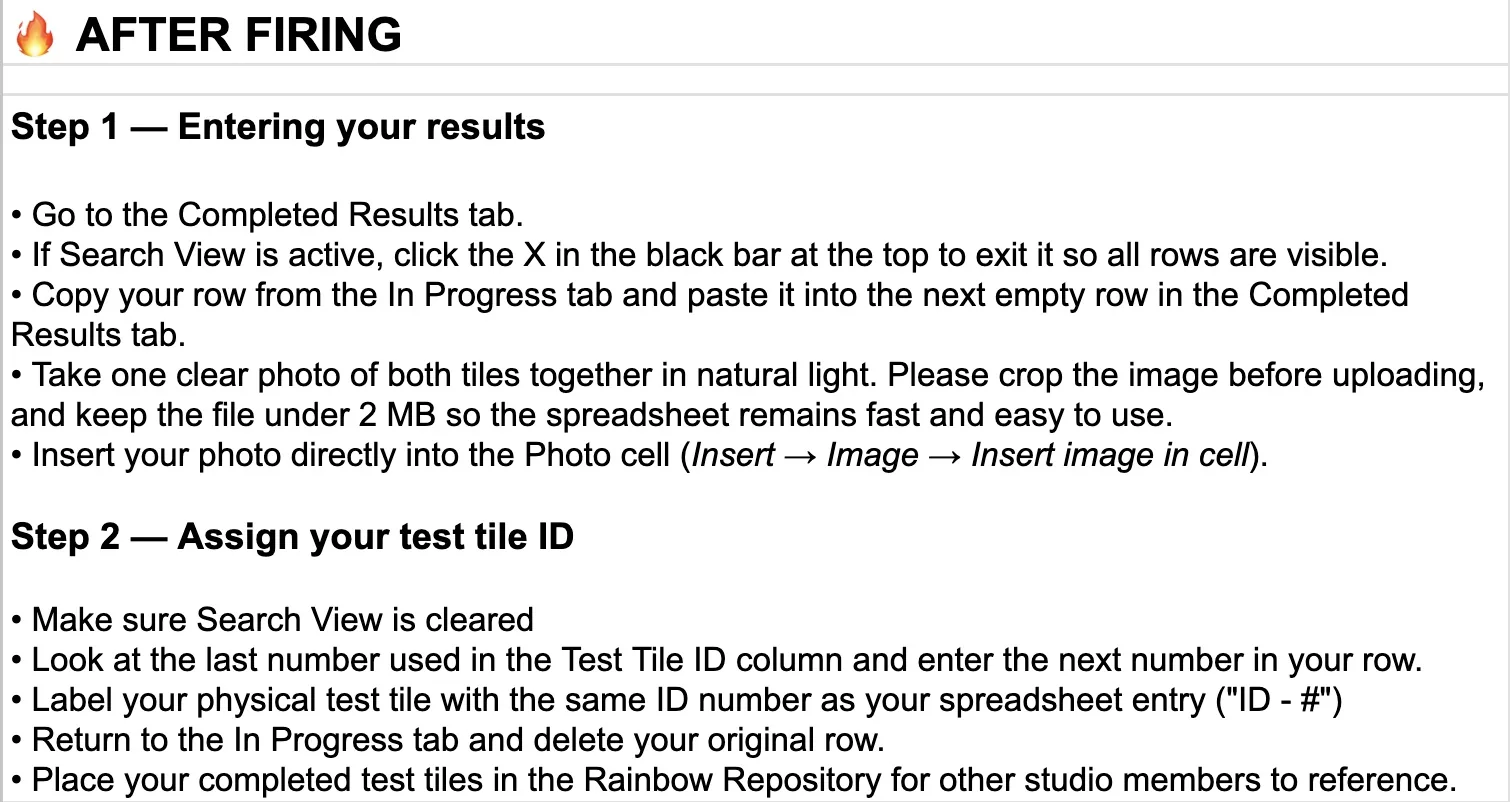
After firing, contributors move their row to Completed Results, photograph both test tiles together in natural light, and insert the image directly into the spreadsheet. I also established a file-size limit for uploaded photos so the shared document would remain responsive as the archive grew.

Creating a structure for reliable data

Each physical test tile needed a permanent connection to its corresponding spreadsheet record. I designed a simple sequential identifier system: contributors assign the next available number and write it directly on the tile. The simplicity was intentional. A system that required contributors to coordinate IDs with one another would be difficult to maintain in a community-run studio.

The system also relies on controlled vocabularies for glaze names and clay bodies. Without them, small naming differences such as "Chun Blue," "Chun blue," and "chun" would fragment the dataset and make filtering unreliable. Maintaining these taxonomies became an ongoing part of the system's governance rather than a one-time setup task.

Designing documentation as part of the experience

Because many studio members had limited experience working in spreadsheets, documentation became part of the design itself. I wrote and illustrated step-by-step instructions explaining how to filter the log, claim a glaze combination, prepare the test tile, photograph results, and upload completed entries.

The goal was to make the workflow clear enough that first-time contributors could use it successfully without needing someone to guide them through the process.

After Firing instructions: entering results and assigning a test tile ID

Step-by-step After Firing instructions guiding contributors through logging results and assigning a test tile ID.

Building institutional memory

The finished system combines a standardized physical testing method with a lightweight documentation workflow that supports a growing, shared archive of glaze knowledge.

Members don't need specialized software, formal onboarding, or a studio manager to guide them through the process. They can filter the log, determine whether a combination has already been tested, reserve new work, and contribute results using a short illustrated guide.

Over time, the spreadsheet has become a form of institutional memory for the studio, allowing knowledge from individual experiments to accumulate into a resource the broader community can use.

What I learned

This project broadened my understanding of information architecture beyond digital products. Without interface constraints, permissions, or validation rules to enforce consistency, I had to design the workflow itself to guide users toward reliable outcomes.

Every decision, including the reservation process, controlled vocabularies, unique identifiers, documentation, and governance model, was aimed at helping a community with varying levels of spreadsheet experience contribute reliable information over time.

The biggest lesson I took away is that good information architecture isn’t just about organizing information. It’s about making knowledge easy to find and contribute to, while creating a system durable enough to outlast the people who built it.